
In a nutshell: Prompt engineering isn’t dying, but the rigid, formula-driven version of it is fading. Thanks to stronger AI reasoning and better context awareness, clear and natural conversation now beats magic-word tricks. This post explains why the old style is disappearing, what skills are replacing it (problem formulation, domain knowledge, and intent-driven interaction), and how to adapt, so you can stop memorizing templates and start thinking more clearly.
The Prompt Engineering Craze: Where It All Began
Cast your mind back to 2023 and 2024. Prompt engineering was the hottest new skill on the internet. At the time, it was often promoted as a potential six-figure career, while various creators sold prompt cheat sheets that claimed to reveal hidden AI shortcuts.
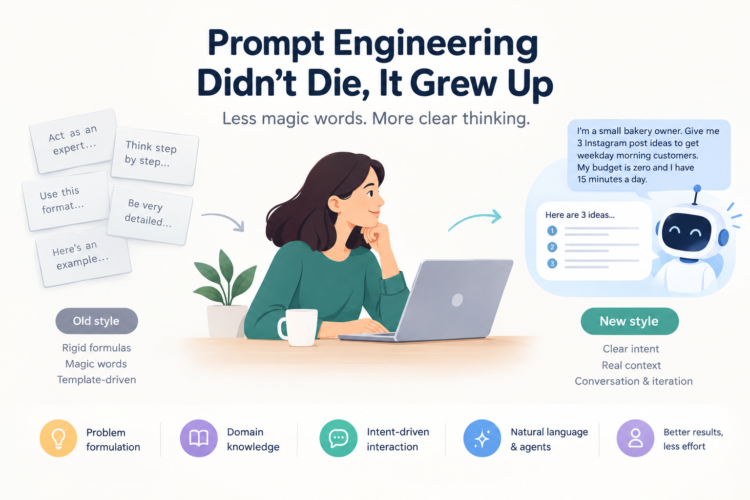
The advice sounded convincing. Start every prompt with “Act as an expert.” Add “think step by step.” Wrap instructions in special formats. Everyone believed the right magic words would separate casual users from power users, and for a while, they were partly right. Early models were sensitive, literal, and easy to confuse, so wording really did matter.
Then the models got better, and a lot of those tricks quietly stopped mattering.
Why Old-School Prompt Engineering Is Fading
The shift didn’t happen overnight, but three changes explain most of it.
Stronger AI Reasoning
Modern models, especially those built to reason through problems before answering, don’t need you to spell out every step. Early systems needed hand-holding, such as numbered rules, rigid templates, and exact phrasing. Today’s models can often work out what a good answer looks like on their own.
That means tricks like “take a deep breath” or elaborate role-play setups add far less than they once did. In many cases, over-constraining a capable model actually makes the output worse, because you’re boxing in a system that could have found a smarter route.
Better Contextual Awareness
Newer AI tools read tone, infer intent, and carry context across a conversation. Tell an assistant you’re writing for busy small-business owners, and it adjusts its language without a formula. Mention a goal early on, and it keeps that goal in mind later.
You no longer have to repeat every detail in every message, as if you were briefing a stranger each time.
Zero-Shot Success
“Zero-shot” simply means asking for something without showing examples. A few years ago, getting a good result often required long prompts packed with samples and rules. Now a clear, natural sentence often does the job. A 500-word system prompt can still help in specialized situations, but for everyday tasks, plain language is usually enough.
From Prompting to Intent and Problem Formulation
So if the magic words matter less, what matters more? The thinking behind the request.
It’s Not How You Say It, It’s What You’re Asking
Compare these two requests:
“Write something about marketing.”
“I run a small bakery and want three Instagram post ideas that bring in weekday morning customers. My budget is zero and I have 15 minutes a day.”
Neither one uses a clever formula. The second works better because the person knows their goal, their audience, and their limits. That’s domain knowledge and clear thinking, not prompt mechanics.
Framing Over Formatting
AI can tidy your formatting, fix your grammar, and restructure your messy notes. What it can’t do is decide what your business strategy should be or which problem is worth solving first. That part remains human.
The valuable skill is now problem formulation: defining the goal, supplying the right context, and knowing what a good outcome looks like. Someone with deep expertise in their field and a basic prompt will usually beat someone with a fancy template and no real understanding of the subject.
Interactive Collaboration
The best results rarely come from one perfect prompt. They come from conversation. You ask, review the response, push back, add detail, and refine. It feels less like programming a machine and more like working with a capable colleague who needs occasional direction.
This is why intuitive conversation is replacing static prompts. Getting good at asking follow-up questions and giving specific feedback beats memorizing a one-shot formula.
The Rise of Natural Language Interfaces and Agents
The change goes beyond chat windows. AI systems are increasingly built to take a goal and handle the steps themselves.
Agents and Orchestration
Tell an AI agent, “Analyze this sales data and draft a report for Friday’s meeting,” and it can break that into smaller tasks: clean the data, find trends, build charts, and write a summary. You state the intent, and the system plans the route. Micro-managing every step with separate prompts becomes unnecessary.
This is intent-driven interaction. You describe the outcome you want, not the procedure for getting there.
Beyond Text
Interaction is also becoming multimodal. You can talk to an assistant, show it a photo or screenshot, or work through a problem in real time. When you can simply say or show what you mean, typing carefully engineered text matters less.
A Realistic Caveat
None of this means structure never matters. Developers building AI products, teams that need consistent outputs, and anyone running repeatable workflows still benefit from carefully written instructions and testing. Precision matters when the stakes are high or the output must be reliable at scale. What’s fading is the idea that ordinary users need secret formulas to get good results.
Prompt Engineering Didn’t Die, It Grew Up
The verdict: prompt engineering didn’t die. It matured. It started as a way to program around a model’s limitations and is becoming a skill closer to communication, which is explaining a problem clearly to a very capable assistant.
So what should you do?
- Stop collecting templates. A folder of 200 prompts won’t help if you can’t describe your own problem.
- Strengthen your domain knowledge. The more you understand your field, the better your questions get.
- Practice defining goals. Before you type, ask yourself what you want, who it’s for, and what “good” looks like.
- Iterate in conversation. Treat the first answer as a draft, not a verdict.
- Verify the output. Smarter AI still makes mistakes, and judgment stays with you.
The people who thrive won’t be the ones who memorized the best spells. They’ll be the ones who think clearly, know their subject, and communicate well, which, not coincidentally, are the skills that have always mattered.
For more practical guides on AI for bloggers and getting more from AI tools, keep following AI Webloggers.