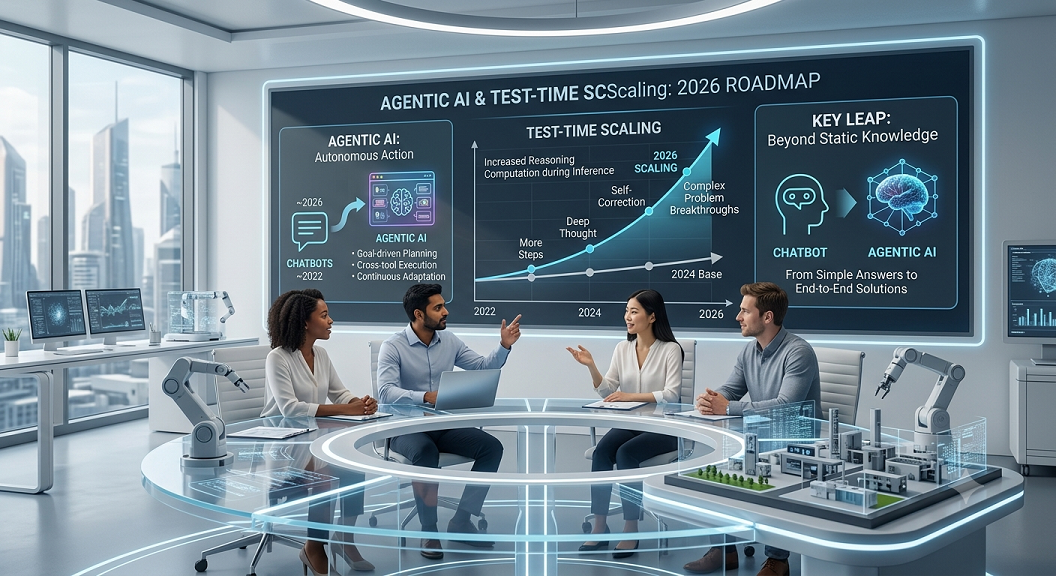
Agentic AI & Test-Time Scaling in 2026: Why They're the Next Big Leap Beyond Chatbots
Discover how Agentic AI and Test-Time Scaling are transforming artificial intelligence beyond traditional chatbots. Learn how AI can reason, plan, and autonomously execute complex workflows, and what these innovations mean for bloggers, businesses, and the future of AI in 2026.
Over the last few years, we've all become familiar with AI chatbots like ChatGPT, Gemini, Claude, and others. They answer questions, write articles, generate code, and even help us brainstorm ideas. But the AI industry is now moving toward something much bigger: Agentic AI and Test-Time Scaling.
These two concepts are being discussed more often in AI research and by leading AI companies because they represent the next stage of artificial intelligence. Instead of simply answering questions, AI systems are beginning to reason, plan, make decisions, and complete complex tasks with minimal human involvement.
As bloggers and AI enthusiasts, I think it's worth understanding these trends because they could change not only how we work, but also how businesses, websites, and online services operate in the coming years.
Let's explore what these terms actually mean.
What Is Agentic AI?
Think of a normal chatbot.
You ask:
"Write me a blog post about AI."
It generates the article.
Job done.
Now imagine asking:
"Create a complete blog around AI tools."
Instead of only writing an article, the AI could:
- Research trending topics.
- Create a content calendar.
- Write multiple blog posts.
- Generate images.
- Optimize SEO.
- Schedule posts.
- Publish them to WordPress.
- Track performance.
- Suggest updates based on analytics.
That is the basic idea behind Agentic AI.
Rather than waiting for one instruction at a time, an AI agent works toward a goal by breaking it into smaller tasks and deciding what to do next.
Why Is It Called "Agentic"?
The word agentic comes from the idea of an agent—a system that can perform actions on your behalf.
Instead of asking for every single step, you simply provide the objective.
For example:
"Help me launch an affiliate marketing website."
An AI agent could:
- Research profitable niches.
- Compare affiliate programs.
- Build a website structure.
- Write initial content.
- Recommend keywords.
- Schedule promotional posts.
- Monitor traffic.
- Suggest improvements.
The AI is no longer just responding—it is actively working toward a goal.
Real-World Examples
Agentic AI isn't limited to blogging.
Imagine an online store.
Instead of a manager checking inventory every day, an AI agent could:
- Monitor stock levels.
- Predict future demand.
- Order new products automatically.
- Notify suppliers.
- Update inventory records.
- Generate sales reports.
Everything happens with minimal human intervention.
Another example is scheduling.
Suppose a company needs to arrange meetings for multiple departments.
An AI agent could:
- Check everyone's calendars.
- Find available time slots.
- Book meeting rooms.
- Send invitations.
- Reschedule if conflicts appear.
That's far beyond what traditional chatbots can do.
What Is Test-Time Scaling?
This is another exciting concept.
Normally, AI models become smarter by being trained on larger datasets using more computing power.
That's called training-time scaling.
Test-time scaling takes a different approach.
Instead of making the model permanently larger, it gives the AI more time and computational effort to think before answering a difficult question.
Imagine asking:
The answer comes instantly.
Now ask:
"Design a complete marketing strategy for a new AI startup."
Instead of replying immediately, the AI may spend extra time:
- Breaking the problem into parts.
- Considering multiple approaches.
- Evaluating different solutions.
- Revising its reasoning.
- Producing a higher-quality answer.
In simple words, the AI "thinks harder" when the task requires it.
Why Does Test-Time Scaling Matter?
Some questions are easy.
Others require reasoning.
For example:
Simple tasks:
- Summarizing text
- Grammar correction
- Translation
Complex tasks:
- Business planning
- Scientific research
- Coding large applications
- Financial analysis
- Long-term project planning
Instead of giving quick but shallow answers, future AI systems will spend additional computation on complex problems.
This often leads to more thoughtful and reliable outputs.
How Bloggers Could Benefit?
As bloggers, we could eventually use Agentic AI to automate many repetitive tasks.
For example, imagine asking:
"Manage my AI blog for the next month."
The AI agent could:
- Research trending topics.
- Analyze competitors.
- Suggest keywords.
- Generate article drafts.
- Create featured images.
- Schedule posts.
- Share articles on social media.
- Monitor rankings.
- Recommend updates for older content.
Instead of juggling several tools, one intelligent system could coordinate the entire workflow.
Of course, human review would still be essential to maintain quality and originality.
What About AI Research?
Researchers also benefit from these developments.
Instead of asking AI a single question, scientists can use AI agents to:
- Search research papers.
- Compare findings.
- Generate summaries.
- Identify knowledge gaps.
- Suggest new experiments.
This can save countless hours while allowing researchers to focus on critical thinking and validation.
Will Agentic AI Replace Jobs?
This question comes up often.
Personally, I think Agentic AI will replace tasks more than people.
Many repetitive activities—like scheduling meetings, organizing files, generating reports, or monitoring systems—can be automated.
But humans are still needed for:
- Creativity.
- Ethical decisions.
- Leadership.
- Customer relationships.
- Strategic thinking.
- Final approvals.
The most successful professionals will likely be those who learn to work alongside AI rather than compete with it.
Challenges to Consider
As exciting as Agentic AI sounds, there are important challenges.
For example:
- What if an AI agent makes a wrong decision?
- How much autonomy should it have?
- Who is responsible if it causes a problem?
- How do we protect sensitive business data?
- Can users trust AI to perform financial or legal tasks independently?
These are questions developers, businesses, and governments will continue to address as AI becomes more capable.
My Thoughts
I think we're witnessing a major shift in AI.
The first generation of AI assistants helped us answer questions.
The next generation will help us complete entire projects.
For bloggers, entrepreneurs, and businesses, this could mean spending less time on repetitive work and more time on creativity, planning, and building meaningful relationships with readers and customers.
That said, I don't believe AI should run everything without oversight. Human judgment, experience, and responsibility will always be important. The best results will come from combining AI's speed with human decision-making.
Final Thoughts
Agentic AI and Test-Time Scaling represent two of the most exciting developments in artificial intelligence. They move AI beyond simple conversations into systems that can reason, plan, adapt, and carry out multi-step tasks with greater independence.
For bloggers, this could mean AI assistants that manage publishing workflows. For businesses, it could mean smarter inventory management, scheduling, customer support, and operations. And for researchers, it could unlock faster discoveries by assisting with complex analysis.
The technology is still evolving, but one thing is becoming clear: the future of AI isn't just about generating answers—it's about achieving goals.
I'd love to hear what everyone thinks.
- Would you trust an AI agent to manage parts of your blog or business?
- Which repetitive task would you automate first?
- Do you think Agentic AI will improve productivity or create new challenges?
Let's discuss!
Keyword Tags:
Agentic AI, Test-Time Scaling, AI Agents, Artificial Intelligence, AI Automation, AI Workflows, Autonomous AI, AI Planning, Reasoning AI, AI Productivity, AI Blogging, Business Automation, Inventory Management, AI Scheduling, Future of AI, AI Trends 2026, Generative AI, AI Research, Machine Learning, Smart Automation, AI Forum, AI Webloggers