OpenAI vs Google vs Anthropic: Who Is Actually Winning the AI Race in Mid 2026?
A structured analysis of where OpenAI, Google DeepMind, and Anthropic actually stand in mid 2026 across model capability, enterprise adoption, safety positioning, and strategic direction.
The AI landscape in mid 2026 looks meaningfully different from where it stood twelve months ago. The gap between the leading labs has narrowed on some dimensions and widened on others. The competitive dynamics have shifted in ways that are not fully captured by the "who released the best model" framing most coverage uses.
This post analyzes where each of the three major labs actually stands across the dimensions that matter: model capability, product integration, enterprise adoption, safety approach, and strategic positioning.
The Framing Problem With "Who Is Winning"
Before the analysis, the framing itself needs addressing. "Winning" in AI in 2026 is not a single-dimension competition. The labs are competing across multiple distinct markets simultaneously:
- Consumer AI products (ChatGPT, Gemini app, Claude.ai)
- Enterprise software integration (API customers, B2B deployments)
- Developer ecosystem (tools, documentation, third-party builds)
- Government and national security relationships
- AI safety credibility (increasingly relevant for regulatory positioning)
A lab can be leading on one dimension while trailing on another. The complete picture requires looking at all of them.
OpenAI: The Distribution Leader
OpenAI's primary competitive advantage in mid 2026 is not model capability. It is distribution.
ChatGPT remains the most widely used AI product globally by a significant margin. The consumer brand recognition gap between ChatGPT and its competitors is the largest remaining moat OpenAI has, and it is meaningful because consumer familiarity drives enterprise procurement decisions at medium-sized companies where AI purchasing decisions are made by non-technical managers.
Where OpenAI leads:
- Consumer product user base and brand recognition
- Third-party integration ecosystem (the largest of any AI provider)
- Microsoft partnership depth (Azure OpenAI, Office 365 integration, Copilot)
- Developer familiarity and documentation quality
Where OpenAI faces pressure:
- Model capability lead has narrowed. Competing models now match GPT-4o on many benchmark categories and exceed it on specific task types.
- Safety reputation has faced scrutiny following several high-profile researcher departures and policy changes that reduced the weight given to safety considerations relative to deployment speed.
- Revenue model sustainability: Consumer subscription revenue at current scale requires continued model differentiation to justify pricing against increasingly capable free alternatives.
Strategic position: OpenAI is playing a distribution and ecosystem game more than a pure model capability game. The Microsoft integration gives it enterprise reach no other lab can match through its own sales motion alone.
Google DeepMind: The Infrastructure Advantage
Google's competitive position in mid 2026 is underappreciated by most coverage that focuses primarily on model benchmark comparisons.
The Gemini model family has reached capability parity with OpenAI's models across most task categories, and leads on specific dimensions including video understanding, multimodal processing, and context window length. But Google's real structural advantage is not the model. It is the infrastructure.
Where Google leads:
- TPU infrastructure: It gives Google a cost-per-inference advantage that is structurally difficult for competitors to match
- Search integration: Gemini's access to live Google Search data gives it a recency advantage that training-data-only models cannot replicate without web browsing features
- Enterprise suite integration: Google Workspace integration with Gemini is now standard across Google's enterprise customer base
- YouTube and video content: The largest video content library in the world is a training and integration advantage no competitor can easily replicate
Where Google faces pressure:
- Consumer AI product adoption has been slower than model capability would suggest. Gemini app usage trails ChatGPT significantly despite comparable model performance.
- Brand confusion across product naming has created market clarity problems that slowed enterprise adoption in some segments.
- Regulatory scrutiny of Google's search dominance intersects with AI integration in ways that create legal risk for deep Gemini-Search integration.
Strategic position: Google is positioned as the infrastructure and enterprise integration play. The TPU cost advantage and Workspace integration make Google the default AI provider for organizations already inside Google's ecosystem, which represents a very large installed base.
Anthropic: The Safety and Trust Positioning
Anthropic's competitive position is the most differentiated of the three and the most misunderstood by coverage that treats safety focus as a capability handicap.
Claude's model family in mid 2026 is competitive with or ahead of GPT-4o on specific task categories including long document processing, instruction following, and nuanced writing tasks. The Mythos model represents the frontier of what is currently deployed in production environments.
Where Anthropic leads:
- Enterprise trust positioning: Anthropic's safety focus has translated into procurement advantages in regulated industries (healthcare, legal, finance) where AI liability concerns make safety reputation a purchasing factor
- Instruction following and long context: Claude consistently outperforms competing models on tasks requiring careful adherence to complex, detailed instructions
- Government relationships: Project Glasswing and similar restricted access programs position Anthropic as a trusted government AI partner in ways that are difficult for competitors with different safety reputations to replicate quickly
- Constitutional AI approach: Anthropic's alignment methodology is more legible to enterprise risk and compliance teams than competing approaches
Where Anthropic faces pressure:
- Consumer product adoption is significantly lower than OpenAI and Google. Claude.ai usage trails both ChatGPT and Gemini app by a large margin.
- Distribution partnerships are fewer and less deep than OpenAI's Microsoft relationship or Google's self-distribution advantage.
- Revenue concentration, Enterprise API revenue is critical and creates dependency on continued enterprise spending in an environment where AI budgets are facing scrutiny.
Strategic position: Anthropic is positioned as the trust and safety premium play. This positioning is most valuable in regulated industries and government, which are high-value markets but narrower than the broad consumer and SMB markets where OpenAI and Google compete.
The Dimensions That Will Determine Mid-Term Outcomes
Looking beyond current snapshots, three factors will most significantly influence competitive positioning over the next 12 to 24 months:
- Inference cost economics: As model capability converges across labs, the cost of running inference at scale becomes the primary differentiator. Google's TPU advantage is structural. OpenAI's Microsoft partnership provides infrastructure scale. Anthropic's infrastructure cost position is the least clear of the three.
- Regulatory positioning: The EU AI Act enforcement, US AI executive orders, and emerging AI governance frameworks in India and other major markets will advantage labs with credible safety positioning when high-risk AI applications face mandatory compliance requirements. Anthropic's positioning is strongest here.
- Ecosystem lock-in: The lab that most successfully embeds its models into tools developers build on top of will create switching costs that outlast any individual model capability advantage. OpenAI currently leads on developer ecosystem depth.
Summary Assessment
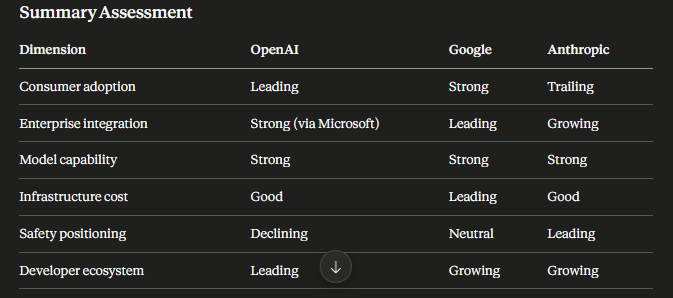
No single lab is winning across all dimensions. The more accurate picture is that each lab is optimizing for a different definition of winning, and those definitions are increasingly diverging rather than converging on a single competitive metric.
For bloggers and content creators, the practical implication is that tool selection based on use case fit rather than "which lab is winning" produces better workflow outcomes than brand loyalty to any single provider.
Tags: OpenAI vs Google, Anthropic AI, AI Race 2026, ChatGPT vs Gemini, Claude AI, AI Competition, Google DeepMind, AI Industry Analysis, Frontier AI Models, AI Strategy 2026