
AI Overviews and answer engines now summarize content instead of sending readers to it, and display ad income is feeling the impact. This guide explains How AI Search Changing Blog Revenue, why AdSense-style earnings are the most exposed, and what publishers are trying instead: AI-citation revenue pools, content licensing, and direct value pricing. You’ll also get a realistic, step-by-step view of what independent bloggers can do now to build more stable income.
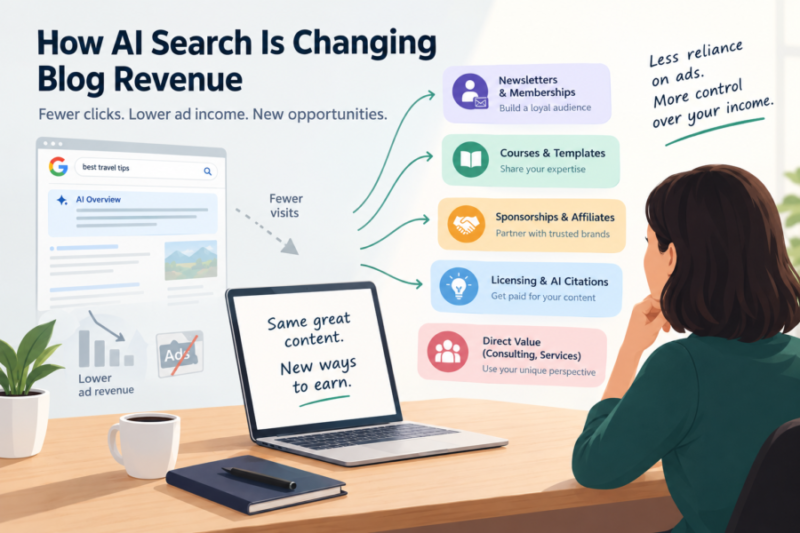
If you’ve checked your AdSense dashboard lately and felt a small knot in your stomach, you’re not imagining things. Pageviews that used to arrive on their own have thinned out, and the income attached to them has thinned out too. Display ads aren’t literally dead, but the system that made them work is under real strain. This post looks at How AI Search Changing Blog Revenue, what publishers are trying instead, and what a realistic response looks like for independent bloggers.
What’s Actually Happening to Your Clicks, How AI Search Changing Blog Revenue?
For years the deal was simple: you published, Google sent readers, and ads paid the bills. AI Overviews and answer engines break that deal by summarizing your content right on the results page.
The numbers back up what bloggers are feeling. The Reuters Institute recorded a 33% drop in organic Google search traffic globally between November 2024 and November 2025, and 38% in the United States. A Similarweb analysis found traffic to the top 100 web publishers fell from a 7 billion monthly peak in August 2024 to 4.9 billion a year later. Looking ahead, a 2026 survey of 280 media leaders found they expect search traffic to fall another 43% over three years.
Small sites have taken real hits. The click economy is literally over, one home improvement blog, Charleston Crafted, lost 70% of its traffic over a few months and saw advertising revenue fall 65%. Not every site is affected equally, but the pattern is clear enough to plan around.
Why Display Ads Take the Hardest Hit
The math is unforgiving. CPM advertising pays a fixed rate per thousand impressions, so revenue moves in lockstep with page views. When referral traffic disappears, CPM revenue disappears with it.
The model that depends most on search is the one that suffers most. Sites funded mainly by high-volume programmatic advertising rely most on transient search traffic, while reader-funded models hold up better. That’s the heart of the shift. You can no longer assume that publishing good content automatically leads to paid impressions.
Pivot 1: AI-Citation Revenue Pools
The first idea gaining ground is paying publishers when AI uses or cites their work. The clearest example so far is Perplexity’s Comet Plus. Participating publishers receive 80% of subscription revenue, with an initial $42.5 million pool set aside for early partners. The money is divided based on direct visits, citations in answers, and use of content by the AI assistant to complete tasks. Perplexity also runs an ad revenue share program that allocates income according to whose content is cited in its answers.
This is encouraging in principle, but be realistic about it. Participation is limited to partners, and these programs are still young. They’re an extra income stream to watch, not a replacement for AdSense.
Pivot 2: Content Licensing and Pay-Per-Crawl
The second pivot is charging AI companies for access. Cloudflare now blocks AI bots by default and has launched a marketplace where publishers can charge for each crawl. Site owners can decide which crawlers to allow, how often, and at what price. The motivation is a lopsided exchange: OpenAI’s crawler reportedly scrapes sites about 17,000 times for every referral it sends back.
A separate effort is the Really Simple Licensing standard. It lets publishers set pay-per-crawl, pay-per-inference, or subscription pricing, though real power arrives only if AI companies agree to honor it.
The caveats matter:
- Cloudflare’s pay-per-crawl began in private beta.
- Most licensing deals so far have gone to major players like The New York Times.
- One analyst argues the licensing market is stalled while Google’s search crawler and AI-training crawler work as a single system, forcing publishers to choose between open access and invisibility in search.
- Blocking everything isn’t a cure. One study found publishers who blocked all AI crawlers saw total traffic fall 23% with no reduction in AI use of their content.
For most independent bloggers, licensing is something to monitor rather than count on today.
Pivot 3: Direct Value Pricing
This is the pivot you can act on now. Instead of earning fractions of a cent per impression, you charge for the value you deliver directly: paid newsletters, memberships, templates, courses, consulting, sponsorships priced on audience quality, or affiliate recommendations built on genuine trust.
Why does this hold up? Subscription revenue means a traffic decline doesn’t translate directly into a revenue decline. A smaller, loyal audience that pays you is worth more than a large, anonymous one that clicks an ad once.
It also fits where AI is weakest. A summary can compress facts, but it can’t replace your tested process, your community, or your point of view.
What Bloggers Can Do Right Now?
- Build an audience you own. An email list can’t be summarized away by a search engine.
- Publish what summaries can’t replace. Original data, first-hand testing, case studies, and strong opinions give readers a reason to click through or come back directly.
- Diversify income. Treat display ads as one stream among several, not the foundation.
- Price for value. Make a product or service you can sell at a fair price, even to a small audience.
- Stay informed on licensing. Review your robots.txt choices carefully, and keep an eye on tools like pay-per-crawl as they open up.
- Measure what matters. Track email signups, repeat visitors, and revenue per reader, not just sessions.
Final Thoughts
By knowing How AI Search Changing Blog Revenue and by breaking the link between a good article and a paid click. Citation pools, licensing, and pay-per-crawl are promising, but they’re early and mostly favor larger publishers. The most dependable path for independent bloggers is a direct relationship with readers who value what you make.
Display ads may fade, but good blogging isn’t going away. The money is just moving closer to the people you actually serve. For more practical guides on AI for bloggers and online income, keep following AI Webloggers.
The 33% / 38% figures hold up, and the caveat next to them matters more than the numbers do. They come from Chartbeat data across roughly 2,500 news sites in the Reuters Institute’s Trends and Predictions 2026 report, and that report says straight out that it is not clear how much of the fall is down to AI Overviews. So the defensible sentence is “organic Google traffic to news sites fell by about a third between Nov 2024 and Nov 2025.” The sentence that travels further, “AI Overviews took a third of your traffic,” is a causal claim nobody has cleanly established yet. Two other things make attribution slippery: the same report has Facebook referrals down 43% and X down 46% over three years, so a blogger looking at a drop should check whether the missing traffic is Google at all before blaming AI summaries. And mixing the Chartbeat series with the Similarweb 7B to 4.9B panel in one argument is comparing two instruments, not one trend. For an individual site the checkable version is on your own dashboard: branded versus non-branded queries, and which referrer lost the visits. That last distinction is most of the work I do now, checking which version of a claim survives a source. Straight read on AI-written claims, drafts or single claims: https://telegra.ph/Before-you-repeat-it-a-straight-read-on-AI-written-claims-10-15