
AI won’t earn money on its own, but it can make real skills faster and more valuable. This guide covers seven practical ways to make money with AI in 2026, including freelance content, blogging, automation consulting, digital products, social media, translation, and training. For each, you’ll see who it suits best and how to start, along with an honest look at the limits so you can pick one path and build from there.
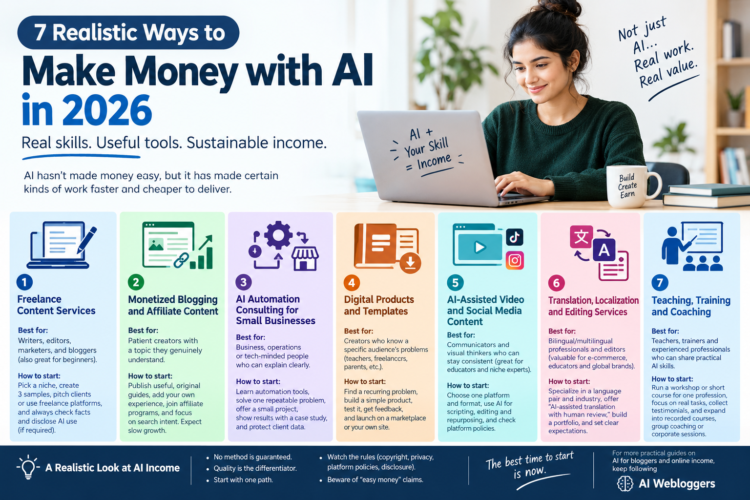
Learning to make money with AI isn’t a shortcut to easy income, but AI has made certain kinds of work faster and cheaper to deliver. The people who successfully make money with AI aren’t pressing a button and waiting for payments. They’re pairing AI tools with a skill, a niche, or an existing audience.
This guide covers seven realistic ways to make money with AI in 2026. Each one includes who it suits and how to start, with no inflated income promises.
1. Freelance Content Services
AI can speed up drafting, outlining, editing, and repurposing. Clients still pay for judgment, accuracy, and a consistent voice, which is where freelancers add value.
Best for who?
Writers, editors, marketers, and bloggers who already understand audience and structure. It’s also a good fit for beginners with strong language skills.
How to start?
Choose a niche you know, such as finance, health, travel, or SaaS. Build three sample pieces, using AI for drafts but rewriting and fact-checking them yourself. Then pitch small businesses or list your services on freelance platforms. Always check facts and disclose AI use if a client requires it.
2. Monetized Blogging and Affiliate Content
AI shortens research and drafting time, so you can publish more helpful content. Income comes from affiliate commissions, ads, sponsorships, or selling your own services.
Best for who?
Patient creators who can commit for months before seeing results. It suits people with a topic they genuinely understand.
How to start?
Pick a narrow topic and publish genuinely useful, original guides rather than generic AI output. Add your own experience, screenshots, and opinions. Join relevant affiliate programs and focus on search intent. Expect slow growth, since traffic and trust take time.
3. AI Automation Consulting for Small Businesses
Many small businesses want to save time on repetitive work like email replies, lead follow-ups, invoicing, and reporting but don’t know where to begin.
Best for who?
People with a business, operations, or tech background who can explain things clearly. You don’t need to be a developer, though comfort with no-code tools helps.
How to start?
Learn a few automation platforms and identify one repeatable problem, such as automatically sorting customer inquiries. Offer a small, fixed-price project to a local business, document the time saved, and use it as a case study. Be careful with client data and privacy.
4. Digital Products and Templates
AI helps you create and refine resources faster, such as planners, prompt libraries, spreadsheet templates, checklists, and mini-courses.
Best for who?
Creators who know a specific audience’s problems, like teachers, freelancers, or parents. It also suits anyone who wants income that isn’t tied to billable hours.
How to start?
Find a problem people repeatedly ask about, then build a simple product that solves it. Test it with a small group, collect feedback, and improve it before launching on a marketplace or your own site. Quality matters more than volume, because a crowded market punishes generic products.
5. AI-Assisted Video and Social Media Content
Tools for scripting, editing, captions, and thumbnails reduce production time. Revenue can come from ad programs, sponsorships, or by driving traffic to your products.
Best for who?
Comfortable communicators and visual thinkers who can stay consistent. It works well for educators and niche experts.
How to start?
Choose one platform and one content format. Use AI for scripting help, editing, and repurposing long content into short clips, but keep your own perspective visible. Review platform policies on AI-generated content and monetization eligibility before you invest heavily.
6. Translation, Localization, and Editing Services
AI gives you a strong first draft in many languages. Businesses still need a skilled human to check tone, cultural fit, and accuracy before publishing.
Best for who?
Bilingual or multilingual professionals, and editors with strong language skills. It’s particularly valuable for e-commerce stores, educators, and companies entering new markets.
How to start?
Specialize in a language pair and an industry, such as product descriptions or educational material. Offer “AI-assisted translation with human review” as a service. Build a portfolio with before-and-after samples, and set clear expectations about what you check.
7. Teaching, Training, and Coaching
Many professionals and small teams want to use AI but don’t know where to start. Teaching practical, job-specific skills is a real service.
Best for who?
Teachers, trainers, and experienced professionals who can translate AI tools into everyday workflows, such as “AI for real estate agents” or “AI for school administrators.”
How to start?
Run a small workshop or short course for one profession. Focus on concrete tasks and show real examples, not hype. Collect testimonials, then expand into recorded courses, group coaching, or corporate sessions.
A Realistic Look at AI Income
A few honest points before you begin:
- No method is guaranteed. Results depend on your skills, niche, effort, and market conditions.
- Quality is the differentiator. When anyone can generate content in seconds, the people who earn are those who add expertise, editing, and trust.
- Start with one path. Trying all seven at once usually means mastering none.
- Watch the rules. Check copyright, client confidentiality, platform policies, and disclosure requirements, which vary by country and platform.
- Beware of “easy money” claims. Courses promising effortless passive income are a red flag.
Final Thoughts
The best way to make money with AI is to attach it to something you already do well. Pick the option that fits your skills and available time, build a small proof of work, and improve from real feedback. For more practical guides on AI for bloggers and online income, keep following AI Webloggers.
Solid list, but the one that quietly eats all the others is the cleanup nobody prices in. Every way above leans on shipping AI-written text fast, and what sinks it later is a single wrong fact: a date, a stat, a name, a “studies show”. A reader catches one and stops trusting the whole blog.
I do a thing I call a straight read: you send the draft, or even just the claim, and I check the facts that carry the piece against real sources and tell you which ones hold, which ones don’t, and which can’t be checked at all, each with the link I actually checked. Cheaper than a rewrite after a commenter calls you out.
I wrote up how it works here: https://telegra.ph/Before-you-repeat-it-a-straight-read-on-AI-written-claims-10-15
And genuinely curious, since this room ships a lot of AI text: which kind of AI “fact” has burned you worst, a wrong number or a confident made-up one?