I get asked this a lot, both here and from friends starting their own blogs: "Can AI actually write SEO-friendly content, or does it just sound good without ranking?"
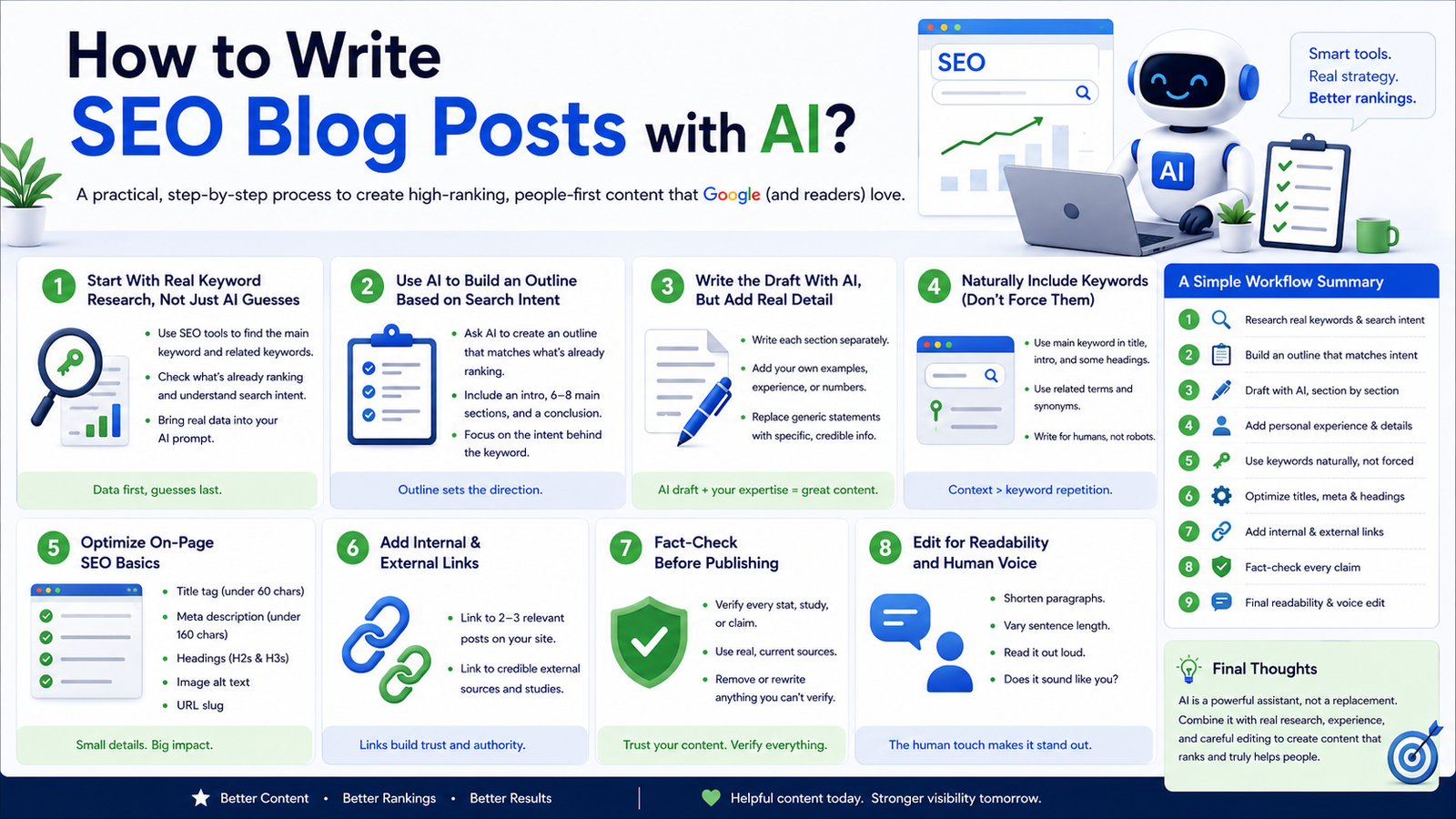
After writing dozens of posts using AI as part of my process, my honest answer is: yes, AI can help you write SEO content, but only if you follow a proper process. Just typing "write me an SEO blog post about X" and publishing whatever comes out usually leads to weak, generic content that doesn't rank well.
Here's the step-by-step process I actually use.
Step 1: Start With Real Keyword Research, Not Just AI Guesses
Before you even open an AI tool to write, you need to know what people are actually searching for. AI can suggest keyword ideas, but it doesn't have live access to real search volume or competition data unless you connect it to a proper SEO tool.
What I do?
- Use a keyword tool (like Ubersuggest, Surfer SEO, or even Google's free Keyword Planner) to find the main keyword and a few related keywords.
- Check what's already ranking for that keyword, so I understand what kind of content (guide, listicle, comparison, etc.) Google expects.
- Then I bring this real data into my AI prompt, instead of asking AI to "guess" what people search for.
This step alone makes a huge difference. Skipping it is the most common reason AI-written posts don't rank.
Step 2: Use AI to Build an Outline Based on Search Intent
Once I know the keyword and what type of content is already ranking, I ask AI to build an outline that matches that intent. For example:
"Create a blog post outline for the keyword '[keyword]'. The top-ranking articles are mostly step-by-step guides. Include an introduction, 6-8 main sections with headings, and a conclusion."
Why this matters? Google rewards content that actually satisfies what searchers want. If people searching your keyword want a step-by-step guide, but your post is just a vague opinion piece, it won't rank well no matter how good the writing is.
Step 3: Write the Draft With AI, But Add Real Detail
This is where I see people go wrong. They get an AI draft and publish it almost exactly as-is. Instead, treat the first draft as raw material:
- Ask AI to write each section separately, not the whole article in one shot. This usually produces more detailed, less repetitive content.
- Add your own examples, personal experience, or specific numbers the AI couldn't know on its own.
- Replace generic statements with specific ones. Instead of "many businesses use SEO," write "73% of small businesses use SEO" (and confirm that the stat is actually real).
This step is also where you build E-E-A-T (Experience, Expertise, Authority, Trust), which search engines care about a lot now. Pure AI text, with no real human experience, struggles to rank competitively, especially for popular topics.
Step 4: Naturally Include Keywords (Don't Force Them)
A common AI SEO mistake is asking the tool to "use this keyword 10 times," which leads to awkward, robotic-sounding sentences. Instead:
- Use your main keyword naturally in the title, the first paragraph, and a couple of headings.
- Use related terms and synonyms throughout the rest of the post, instead of repeating the exact same phrase.
- Read the post out loud (or have someone else read it). If a sentence sounds forced just to fit a keyword, rewrite it.
Search engines today understand context and meaning, not just exact keyword matches. Writing naturally usually performs better than keyword-stuffed content anyway.
Step 5: Optimize On-Page SEO Basics
After the writing is done, go through a basic on-page SEO checklist:
- Title tag: Include your main keyword, keep it under 60 characters if possible.
- Meta description: Write a short, compelling summary (under 160 characters) that includes the keyword naturally.
- Headings: Use H2s and H3s with relevant keywords and subtopics, not just generic labels.
- Image alt text: Describe images clearly, including a keyword where it makes sense naturally.
- URL slug: Keep it short and keyword-focused (e.g., /how-to-write-seo-blog-posts instead of a long random string).
AI tools can help generate suggestions for all of these, but always read them yourself to make sure they sound natural and accurate.
Step 6: Add Internal and External Links
This step gets skipped a lot when people write quickly with AI, but it matters:
- Internal links: Link to 2-3 other relevant posts on your own blog. This helps search engines understand your site structure and keeps readers exploring more of your content.
- External links: Link out to a couple of credible, trustworthy sources, especially for any stats or claims. This builds trust with both readers and search engines.
I always do this step manually after the AI draft is done, since AI tools don't usually know your site structure or which other posts you've already published.
Step 7: Fact-Check Before Publishing
AI can confidently generate wrong information, especially numbers, studies, or specific claims. Before publishing:
- Verify every statistic or fact against a real, current source.
- Check that any "studies show" claim actually refers to a real study.
- Remove or rewrite anything you can't verify within a few minutes of searching.
This step protects both your SEO (wrong information hurts trust signals over time) and your reputation with readers.
Step 8: Edit for Readability and Human Voice
Before hitting publish, do one final pass focused purely on readability:
- Break up long paragraphs into shorter ones.
- Vary your sentence length so it doesn't sound robotic or repetitive.
- Read it once more and ask yourself: "Does this sound like a person who actually understands this topic, or does it sound generic?"
This final human touch is often what separates AI-assisted content that ranks well from AI content that blends into the pile of similar-sounding articles online.
A Simple Workflow Summary
If you want a quick checklist version, here's what I follow every time:
- Research real keywords and search intent
- Build an outline that matches what's already ranking
- Draft with AI, section by section
- Add personal experience and specific details
- Use keywords naturally, not forced
- Optimize titles, meta descriptions, and headings
- Add internal and external links
- Fact-check every claim
- Final readability and voice edit
Final Thoughts
AI is genuinely one of the best tools available for speeding up SEO blog writing, but it works best as a strong assistant, not a replacement for your own judgment and effort. The bloggers who get good results with AI are the ones who combine it with real keyword research, personal experience, and careful editing, not the ones who just copy-paste whatever the AI generates.
What's your current process for writing SEO content with AI? Would love to compare notes and pick up a few tips from others here.
SEOBlogWriting , AIContentWriting , SEOTips , BloggingWithAI , ContentMarketing , KeywordResearch , OnPageSEO , AIForBloggers , SEOStrategy , ContentWritingTips , BlogSEO , DigitalMarketing , AIWritingTools , SEOForBeginners