Hi everyone,
One question that comes up frequently in AI communities is:
"How can I avoid AI detection?"
I think that's the wrong question.
A better question is:
"How can I use AI to create original, helpful, and trustworthy content?"
In 2026, AI writing tools have become incredibly powerful, but AI detection tools have also improved. Schools, publishers, businesses, and some websites use these tools to estimate whether text may have been generated by AI. However, it's important to understand that AI detectors are not perfect. They make predictions based on writing patterns and can produce both false positives (human writing flagged as AI) and false negatives (AI text not flagged).
Rather than trying to "beat" detection tools, writers should focus on creating content that genuinely reflects their own knowledge and experience.
Let's look at how these tools generally work and what writers can do to produce better content.
What Are AI Detection Tools?
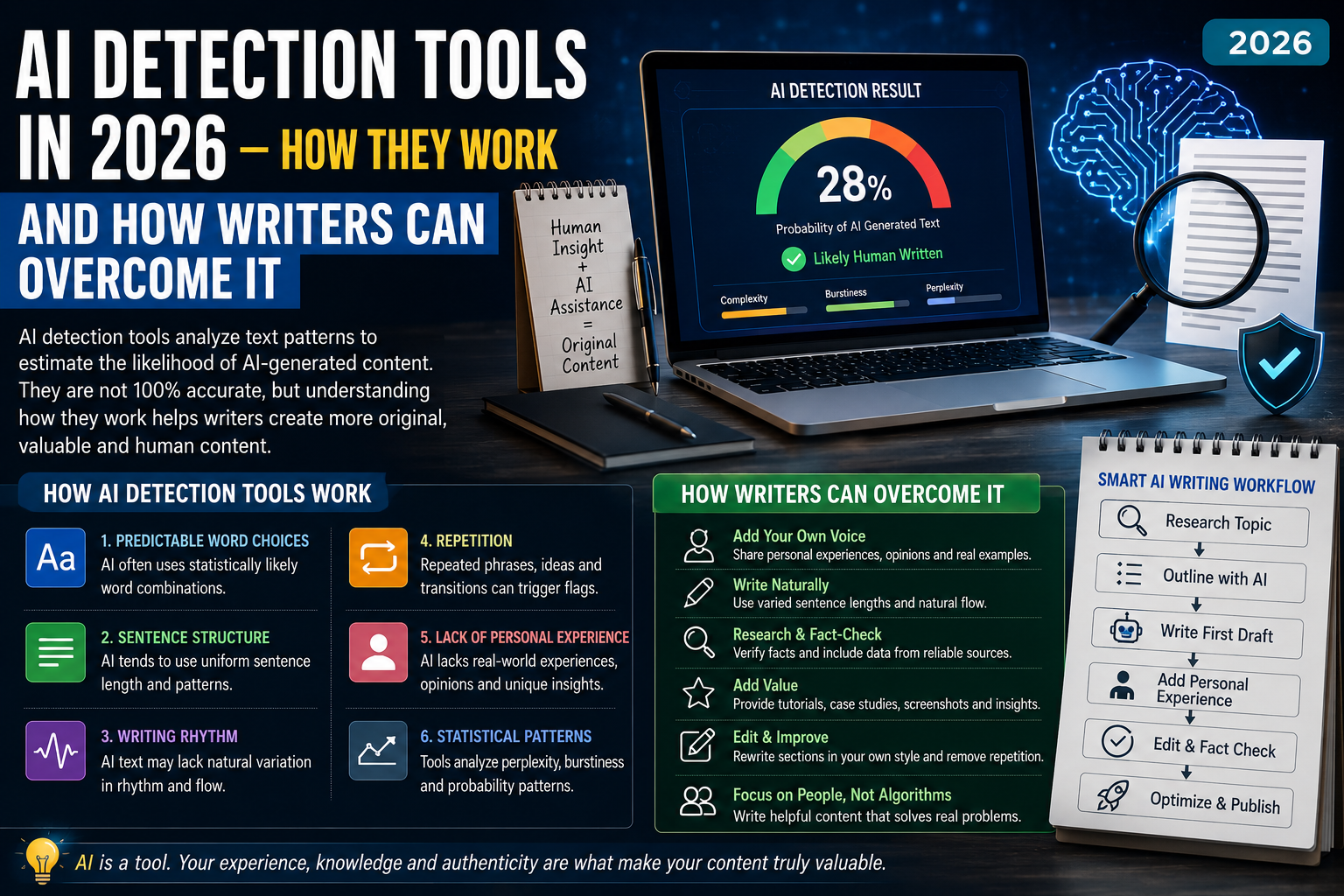
AI detection tools analyze a piece of text and estimate how likely it is to have been generated by an AI model.
They do not know for certain who wrote the content.
Instead, they examine different characteristics of the writing and assign a probability or confidence score.
Think of them as pattern-recognition systems rather than lie detectors.
How Do AI Detection Tools Work?
Although every detector uses different methods, many of them look at patterns such as:
1. Predictable Word Choices
AI models often choose words that are statistically likely to appear together.
Highly predictable writing may increase the likelihood of being flagged.
2. Sentence Structure
AI-generated drafts sometimes contain sentences with very similar lengths and patterns.
Human writers usually vary sentence length naturally.
3. Writing Rhythm
People naturally mix short sentences, longer explanations, questions, and examples.
AI drafts can sound too smooth or uniform if left unedited.
4. Repetition
AI sometimes repeats:
- Ideas
- Phrases
- Sentence openings
- Transitions
This repetitive style can make content feel less natural.
5. Lack of Personal Experience
One of the biggest differences between AI-generated text and human writing is personal experience.
Humans often write things like:
"When I tested this tool..."
"In my own blog..."
"I made this mistake..."
Those kinds of insights are difficult for AI to invent responsibly.
Can AI Detectors Be Wrong?
Yes.
This is one of the biggest limitations.
Some human-written articles have been incorrectly labeled as AI-generated.
Likewise, heavily edited AI-assisted writing may not be flagged.
For this reason, AI detector results should be treated as estimates, not proof.
Does Google Penalize AI Content?
A common myth is:
"Google automatically punishes AI content."
That's not accurate.
Google's focus is on content quality, not whether AI assisted in writing it.
Helpful, original, people-first content is much more important than whether AI was involved in the drafting process.
Low-quality, repetitive, or spammy content can perform poorly regardless of whether it was written by a person or an AI.
Should Bloggers Stop Using AI?
Definitely not.
AI is one of the best productivity tools available today.
It can help with:
- Brainstorming ideas
- Creating outlines
- Improving grammar
- Summarizing information
- Writing FAQs
- Suggesting titles
- Improving readability
The key is using AI as an assistant rather than letting it replace your thinking.
A Better Workflow for Writers
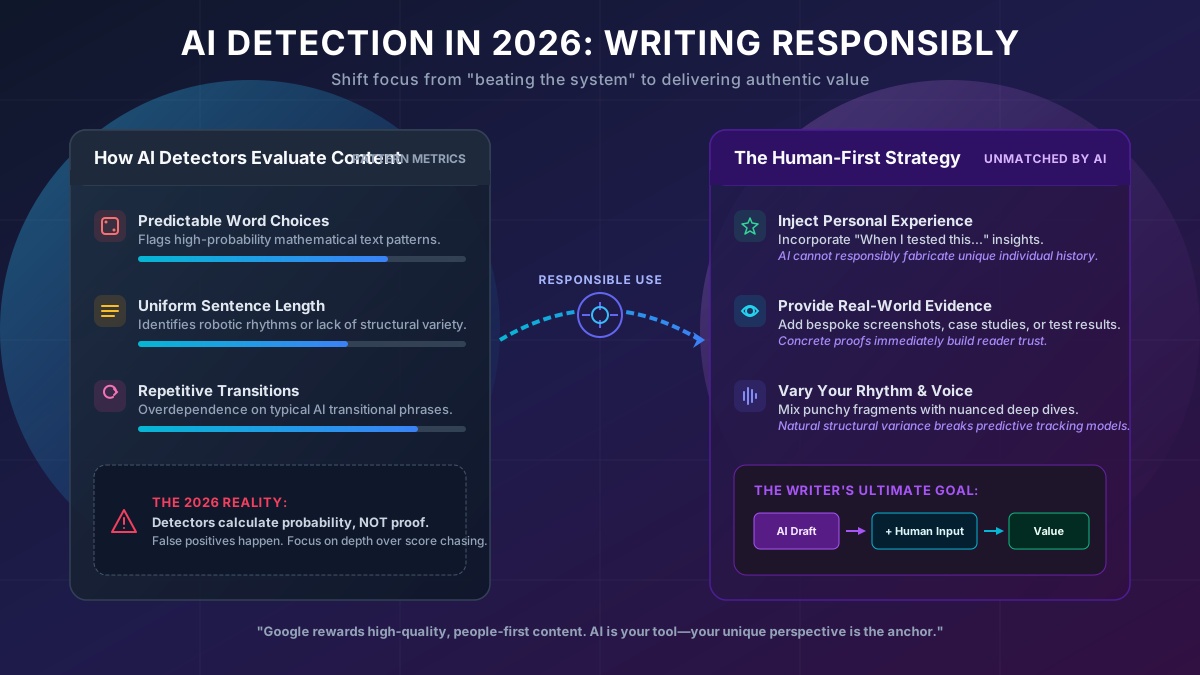
Here's a workflow that has worked well for me:
Choose a topic
↓
Research from reliable sources
↓
Create an outline with AI
↓
Write the first draft
↓
Add personal opinions
↓
Include examples
↓
Verify important facts
↓
Edit for clarity
↓
Publish
This approach produces content that is far more useful than simply copying an AI-generated draft.
Add Your Own Voice
Readers don't visit your blog because you own an AI tool.
They visit because they want your perspective.
Try adding:
- Lessons you've learned
- Mistakes you've made
- Personal recommendations
- Screenshots
- Real results
- Practical tips
These details make your content more authentic and valuable.
Don't Chase Detection Scores
I've seen some writers become obsessed with getting "0% AI detected."
Personally, I think that's the wrong goal.
Detection tools can disagree with one another, and their scores can change over time.
Instead of spending hours trying to change a percentage, spend that time improving the quality of your article.
Ask yourself:
- Does this answer the reader's question?
- Is it accurate?
- Is it easy to understand?
- Does it include something unique?
Those questions matter much more than a detector score.
Common Mistakes Writers Make
Here are a few mistakes I see regularly:
- Publishing the AI's first draft without editing.
- Adding keywords unnaturally.
- Repeating the same ideas.
- Skipping fact-checking.
- Writing without considering the reader.
- Depending completely on AI.
Avoiding these mistakes improves both quality and credibility.
What Makes Content Feel Human?
From my experience, good writing usually includes:
- Personal observations
- Natural sentence variation
- Honest opinions
- Real examples
- Practical advice
- Clear explanations
- Helpful structure
Those qualities are useful whether AI assisted with the draft or not.
My Personal AI Writing Routine
Whenever I write with AI, I follow a simple routine:
- Research the topic myself.
- Ask AI to organize the information.
- Rewrite sections in my own style.
- Add my own thoughts and examples.
- Check facts carefully.
- Read the article aloud before publishing.
Reading the article aloud often helps me spot awkward or repetitive wording that I might otherwise miss.
AI Is a Tool, Not the Author
One lesson I've learned is that AI should handle repetitive tasks while humans handle creativity, judgment, and experience.
AI can help produce a first draft in minutes.
Turning that draft into something worth reading is still the writer's job.
That's where the real value comes from.
Final Thoughts
AI detection tools will probably continue improving, but so will AI writing tools.
Instead of treating this as a race between generators and detectors, I think writers should focus on creating content that is accurate, original, and genuinely useful.
The goal shouldn't be to "hide" AI use. The goal should be to use AI responsibly while adding your own knowledge, experience, and personality.
Readers remember helpful content—not whether it was drafted with AI assistance.
I'd love to hear what others think.
- Do you use AI detectors before publishing?
- Have you ever had human-written content flagged as AI?
- What's your workflow for combining AI assistance with your own writing?
Let's discuss!
Keyword Tags:
AI Detection, AI Writing, ChatGPT, AI Blogging, Content Creation, Original Content, AI Tools, Writing Tips, SEO, Human Writing, Content Strategy, AI Productivity, Fact Checking, Blogging Tips, Responsible AI