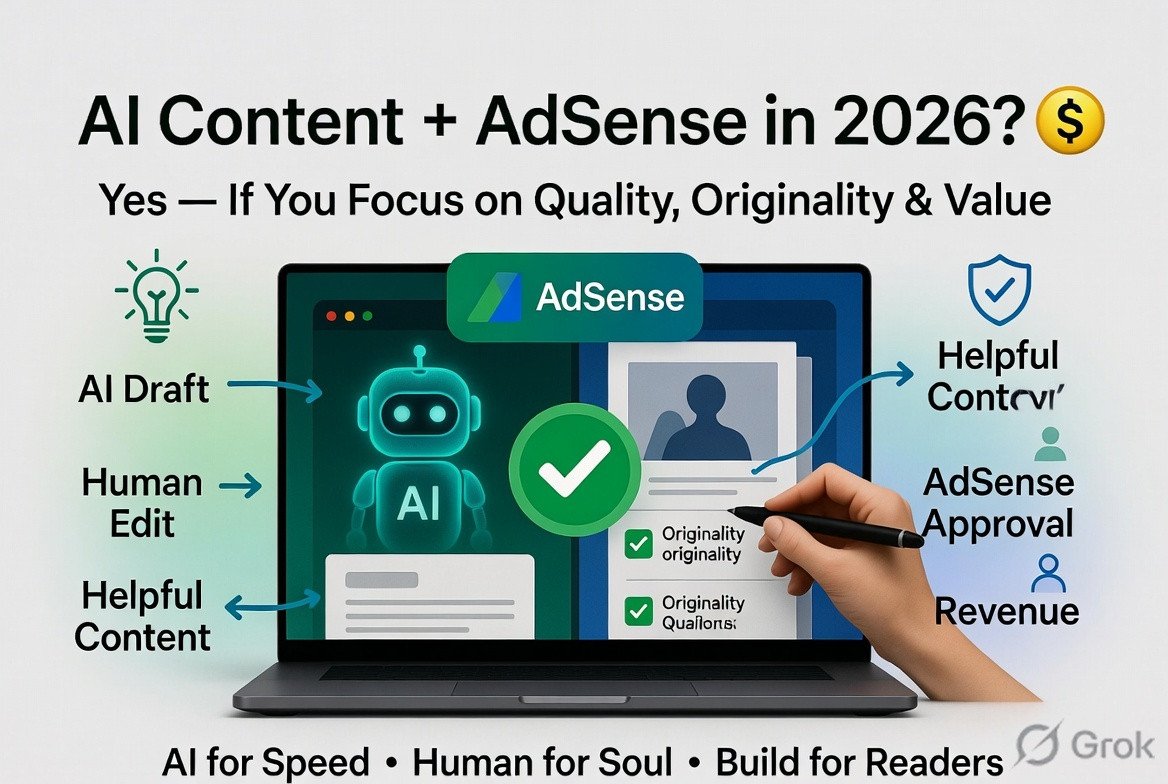
Can You Get AdSense Approval Using AI-Generated Content in 2026? Here's What Every Blogger Should Know..
One of the most common questions I see in blogging communities is:
"Can I get Google AdSense approval if I use AI to write my articles?"
The short answer is yes, but only if the content is original, useful, and created for readers rather than just for search engines.
Many people think Google automatically rejects websites because they use AI. From what I've learned, that's not how it works. Google is more interested in the quality of the content than whether AI helped create it.
In this post, I'd like to share what I've learned about using AI responsibly while building an AdSense-friendly website.
Is AI Content Allowed by AdSense?
Yes, AI-assisted content can be eligible for AdSense.
However, simply generating hundreds of AI articles and publishing them without editing is unlikely to produce a high-quality site. AdSense reviewers look at the overall quality of a website, including whether it provides value to visitors.
The important point is this:
AI is a writing assistant, not a replacement for creating helpful content.
What Does AdSense Actually Look For?
In my opinion, AdSense approval depends on several important factors.
1. Helpful Content
Every article should answer a real question or solve a real problem.
Readers should leave your page feeling that they learned something useful.
2. Original Content
Even if AI helps write a draft, make sure you:
- Add your own opinions.
- Rewrite sections where necessary.
- Include practical examples.
- Share personal experiences if possible.
This makes the content unique.
3. Easy Navigation
Visitors should be able to move around your website easily.
Categories, menus, and internal links all improve the user experience.
4. Trust
Websites that appear trustworthy usually perform better.
Simple things help, such as:
- About page
- Contact page
- Privacy Policy
- Clear author information
These pages show that your website is genuine.
I've seen many beginners do something like this:
Generate 300 AI articles.
Publish them all.
Apply for AdSense.
Then wonder why they get rejected.
Quantity alone doesn't build a quality website.
Instead of asking,
"How many posts do I need?"
it's better to ask,
"Would a visitor actually find these articles useful?"
AI Should Save Time, Not Replace Quality
I personally use AI to help with:
- Brainstorming blog topics
- Creating outlines
- Improving grammar
- Suggesting headings
- Writing FAQs
- Generating meta descriptions
After that, I edit everything myself.
I also remove repetitive sentences and add examples wherever possible.
Why Human Editing Matters?
AI can produce impressive first drafts.
But it can also:
- Repeat ideas
- Miss context
- Include outdated information
- State incorrect facts confidently
That's why every article should be reviewed before publishing.
Even ten minutes of editing can significantly improve readability.
Don't Ignore Experience
Readers trust people, not machines.
If you've actually used a tool, visited a place, or solved a problem yourself, mention it.
For example:
Instead of writing:
"This AI tool is useful."
You can write as:
"I used this AI tool to create ten blog outlines in one afternoon, and it reduced my planning time considerably."
Specific examples make content more believable.
Focus on One Niche
One mistake many new bloggers make is writing about everything.
A focused website often builds authority more quickly.
Examples include:
- AI Blogging
- SEO
- WordPress
- Digital Marketing
- AI Tools
- Content Creation
A clear niche also helps visitors know what to expect.
Build a Real Website
Before applying for AdSense, make sure your website looks complete.
Some useful pages include:
- Home
- About
- Contact
- Privacy Policy
- Disclaimer
- Categories
- Archive
A professional structure creates a better first impression.
Keep Publishing Consistently
One excellent article every few days is usually better than publishing dozens of low-quality posts in a single week.
Consistency builds trust with readers.
It also helps improve your overall content library over time.
Don't Chase Word Count
Many beginners believe:
"Longer articles always rank better."
Not necessarily.
A 900-word article that completely answers a question can be much more valuable than a 3,000-word article filled with unnecessary repetition.
Write only as much as the topic needs.
Avoid These Mistakes
Here are a few things I'd avoid:
- Publishing AI content without reading it.
- Copying content from other websites.
- Creating hundreds of nearly identical articles.
- Using misleading titles.
- Filling pages with unnecessary keywords.
- Ignoring spelling and grammar.
- Publishing articles with no images or formatting.
Make Your Content Stand Out
AI gives everyone access to similar information.
Your job is to add something extra.
You can include:
- Personal opinions
- Screenshots
- Tutorials
- Step-by-step guides
- Comparisons
- Case studies
- Real results
- Frequently Asked Questions
This creates value that generic AI content often lacks.
Think About the Reader
Whenever I finish an article, I ask myself:
- Does this answer the reader's question?
- Is everything easy to understand?
- Would I recommend this article to someone else?
- Does it provide practical advice?
If the answer is yes, I'm usually happy to publish it.
My AI Blogging Workflow
Here's the process I currently follow:
Research Topic
↓
Create Outline with AI
↓
Write Draft
↓
Add Personal Experience
↓
Verify Facts
↓
Improve Formatting
↓
Add Images
↓
Internal Links
↓
Final Proofreading
↓
Publish
This workflow takes a little longer than copying AI output directly, but the final result is much better.
Can AI Websites Earn Good AdSense Revenue?
Absolutely—but only if they attract real readers.
AdSense earnings depend on factors such as:
- Traffic quality
- User engagement
- Niche
- Advertiser demand
- Helpful content
AI can help produce articles faster, but it cannot guarantee traffic or revenue.
Build for the Long Term
One lesson I've learned is that AdSense isn't just about getting approved.
The real goal is building a website people return to again and again.
That means creating content that's useful, trustworthy, and updated regularly.
AI can speed up the process, but it's your ideas and experience that keep readers coming back.
Final Thoughts
I don't believe bloggers should be afraid of using AI. Instead, they should learn how to use it responsibly.
If AI helps you organize your thoughts, improve your writing, and save time, that's a positive thing. But if it's used to mass-produce low-value content with no editing or originality, it becomes much harder to build a successful website.
For me, the winning formula is simple:
AI for productivity + Human creativity + Original value = A stronger blog.
If you focus on helping readers first, AdSense becomes a natural step rather than the only goal.
I'd love to hear your thoughts.
- Have you received AdSense approval on an AI-assisted blog?
- What practices have worked well for you?
- Do you edit every AI draft before publishing?
Let's discuss and help each other build better AI-powered websites.
Keyword Tags:
Google AdSense, AI Generated Content, AI Blogging, AdSense Approval, Content Creation, ChatGPT, SEO, Blog Monetization, AI Tools, Original Content, Content Strategy, Website Quality, Digital Marketing, Blogging Tips, AdSense 2026, AI Content Writing, E-E-A-T, AI Productivity, Blog Growth, Monetization with AI, AI Forum, AI Webloggers