Anthropic's Claude Fable 5 and Mythos 5 Are Back: What Happened and What It Means for AI Users
US export controls on Claude Fable 5 and Mythos 5 are lifted. Find out why they were blocked, how the ban was resolved, and what it means for AI users globally.
Hey everyone. Big news dropped today that directly affects the AI tools we use as bloggers and content creators. Anthropic just confirmed that the US government has lifted its export controls on Claude Fable 5 and Mythos 5, two of the most powerful AI models currently available. Here's a clear breakdown of the full story, from why the ban happened to what comes next.
First, What Are Fable 5 and Mythos 5?
If these names are new to you, here's a quick background.
Anthropic released Claude Fable 5 as a public version of its more advanced Mythos model, but with additional safety restrictions in place, particularly around cybersecurity, biology, and chemistry related queries. Mythos 5, on the other hand, was initially offered only to top tech companies, governments, and financial institutions, since Anthropic itself described it as a highly sophisticated model capable of finding and exploiting previously unknown vulnerabilities in digital infrastructure.
In simple terms, Mythos 5 is the more powerful, less restricted version. Fable 5 is the public-friendly version with extra guardrails built in.
So What Happened? Why Were They Blocked?
The freeze started on June 12, when the US government applied export controls to both models. Because the order took effect immediately and Anthropic could not verify users' nationality in real time, it had to suspend access for everyone rather than risk breaching the rule.
The trigger was a jailbreak discovered by a trusted partner, which CNN later confirmed was Amazon, meaning someone found a way to get around Fable's guardrails. Anthropic said at the time the jailbreaks were "simple" and that other publicly available models had similar workarounds.
Anthropic disabled access to Fable 5 and Mythos 5 in mid-June in order to comply with the export control directive from the government, which cited "national security authorities." The company said it was told to suspend all access by any foreign national, whether inside or outside the United States, including foreign national Anthropic employees.
So to be clear: even Anthropic's own employees who were not US citizens lost access to the models during this period. That tells you how broad and sudden the restriction was.
Why Was This a Big Deal Beyond Just Anthropic?
This wasn't just an inconvenience for Anthropic users. The wider AI and tech industry was watching closely for two important reasons.
The government's crackdown on Anthropic coincided with a swift rise in Chinese open-source models that were proving to be almost as capable and significantly cheaper than some of the most powerful US models. With the Trump administration limiting Anthropic's rollout of its latest models, a number of tech executives and investors raised concern that Chinese developers were being gifted valuable time in their effort to catch up.
Tanishq Abraham, a former research director at Stability AI, described the situation as raising important questions for how frontier AI labs should interact with the US government. He noted: "The biggest question now is: What precedent does this set for the industry? Does the US government need to approve every frontier model release?"
That last question is one the entire AI industry is now asking. If a security issue in one model can trigger a blanket government ban across all users globally, it changes how AI companies need to think about releasing powerful models.
How Was the Ban Resolved?
A source at Anthropic confirmed the company implemented a new safeguard to directly address and block the vulnerabilities reported by Amazon. The Commerce Department then worked with Anthropic to review the updated models before lifting restrictions.
Commerce Secretary Howard Lutnick wrote in a letter that he had determined "appropriate safeguards" were in place to permit certain "trusted partners" to access the model first. Days before the full lifting of controls, Anthropic was granted permission to release Mythos 5 to a select group of companies and federal agencies.
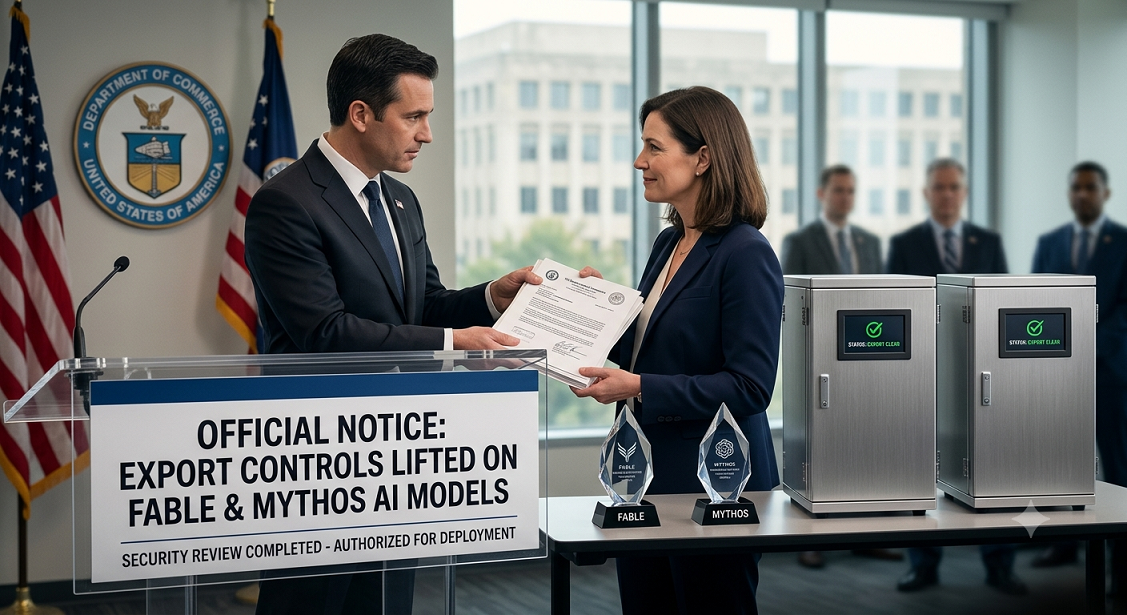
Then on June 30, the full export controls were lifted, and access began restoring from July 1 (today).
What Access Is Being Restored and How?
Fable 5 will again be available to global users on the Claude platform, Claude.ai, and Claude Code starting Wednesday. The model will also be included for up to 50% of weekly usage limits through July 7 for users of Pro, Max, Team, and selected enterprise plans.
Mythos 5, which shares the same underlying model as Fable 5 but carries fewer safety restrictions, is being restored to a set of US organizations only after government approval on June 26, not to the general public yet.
Anthropic will also re-enable access to Fable 5 on Amazon Web Services, Google Cloud, and Microsoft Foundry as soon as possible.
So if you're a regular Claude user, Fable 5 is coming back to you today. Mythos 5 access remains limited to approved US organizations for now.
What Does This Mean Going Forward?
Three things stand out from this entire episode that are worth paying attention to:
First, AI model releases can now be paused by governments. This sets a precedent that powerful AI models are subject to national security review. As AI gets more capable, expect this kind of government involvement to become more common, not less.
Second, security vulnerabilities in AI are being treated seriously. The fact that a single jailbreak triggered a nationwide ban shows how seriously cybersecurity risks in frontier AI models are being treated at the policy level. As AI bloggers and users, it's worth understanding that these tools carry real-world security implications beyond just content generation.
Third, the relationship between AI companies and governments is changing shape. The intervention underscores Washington's growing scrutiny of advanced AI technologies. Like Anthropic, rival AI lab OpenAI also complied with requests from the US government to restrict the release of its own powerful new model, GPT-5.6, to a limited set of approved partners.
This means Anthropic isn't alone in navigating this tension. It's an industry-wide shift in how frontier AI gets released and regulated.
What Should Bloggers and Creators Take From This?
From a practical standpoint, this episode reinforces something worth building into your content workflow: never depend entirely on a single AI tool. The Fable 5 and Mythos 5 shutdown showed that even a top-tier, widely-used model can go offline suddenly and without much warning.
Having a backup workflow with alternative tools (Claude, ChatGPT, Gemini, Perplexity) means your content pipeline doesn't come to a complete stop when one tool goes down, for any reason, whether technical, regulatory, or otherwise.
The good news is that Fable 5 is back as of today. If you've been holding off on using it, now's a good time to test it since access is being prioritized for existing plan users through July 7.
Drop your thoughts below. Are you relieved it's back, or does this whole episode make you think differently about relying on closed AI models for your workflow?
Tags: Anthropic News, Claude Fable 5, Claude Mythos 5, AI Export Controls, US AI Regulation, AI National Security, Anthropic Government, AI Policy 2026, Frontier AI Models, AI Tools Update, AI Forum, AI Webloggers